Friday, May 16, 2014

Athens - Day One

Athens from the air

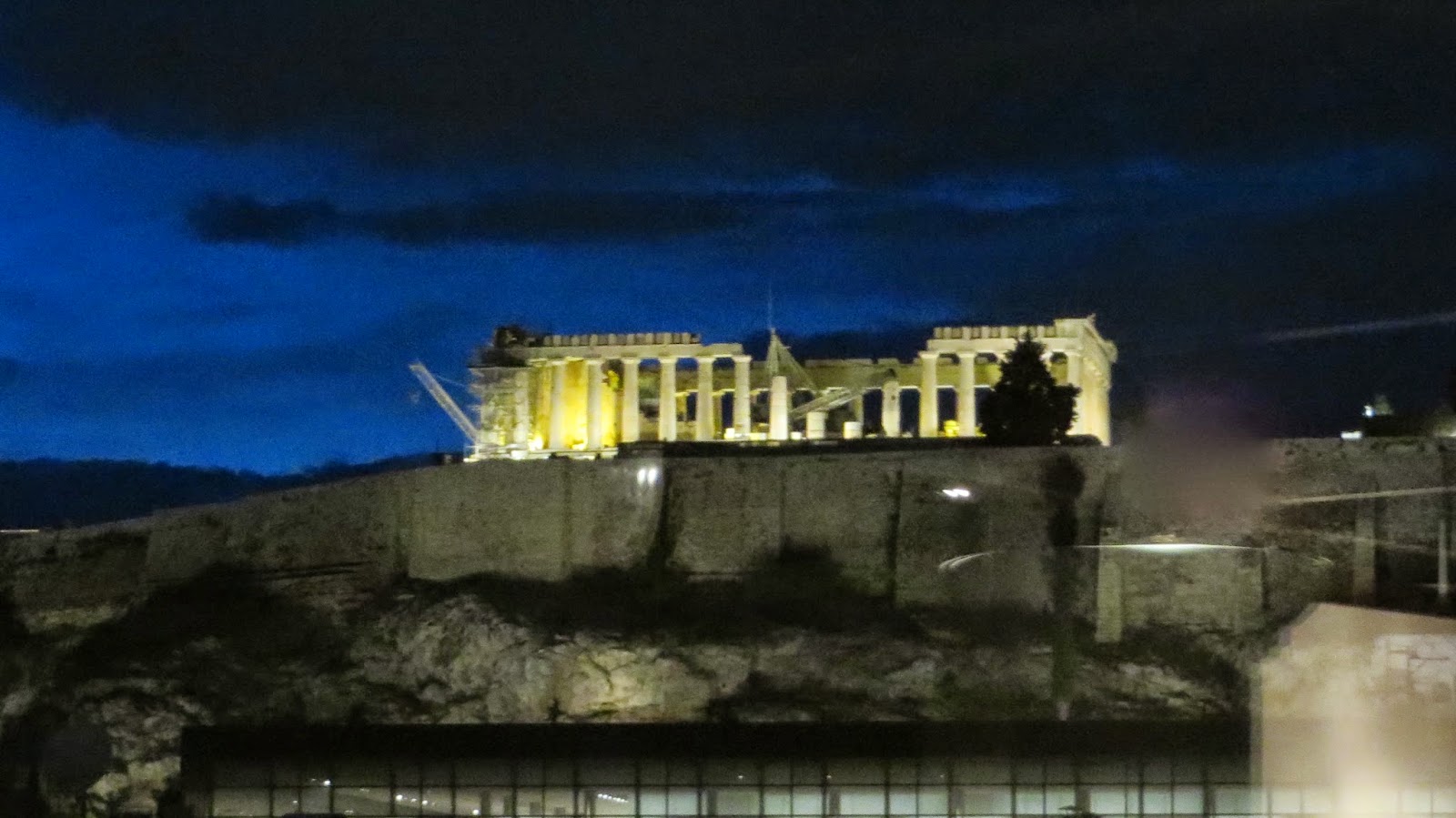
The Parthenon at night, viewed from our hotel
We arrived in the evening and only had time for dinner.  Tomorrow the vacation starts, as we get a tour of Athens, free time to explore further, and then we're off to the coast to embark our small ship, the Artemis.

Wednesday, April 9, 2014

Beautiful - Surprisingly Beautiful


EasternEurope to the Black Sea - Vidin, Bulgaria

I never dreamed I'd see Bulgaria, or that I would even want to.  As a child of the 60s, all I knew was it was part of the USSR, they were Communists and it was all controlled by the Russians.  We hated the Russians.  Turns out, so did the Bulgarians.  

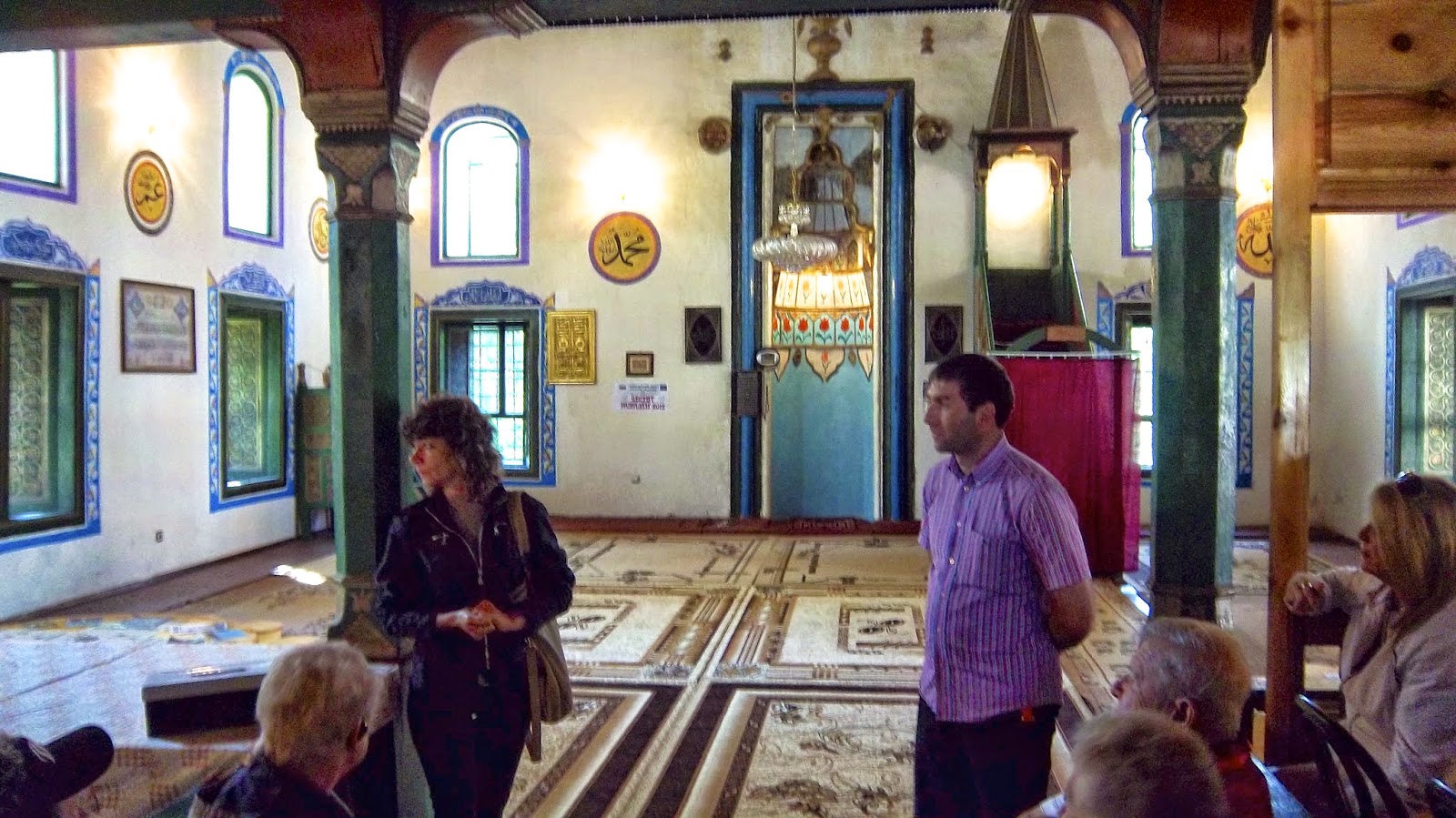
Now they are free, but struggling with a poor economy and no real industry.  They are trying to develop tourism, since they are right on the Danube, and close to the Black Sea, but the area is not well known.   Our riverboat made two stops in Bulgaria, at Vidin and at Ruse.   In Vidin we visited a mosque, right across from an Eastern Orthodox church  The imam didn't speak English, but he did speak Italian.  Our Program Director, who is Romanian and speaks no Bulgarian, found an Italian guide who spoke English. Voila!   


Vidin

The translator and the Imam
The Imam was dressed in normal street clothes, which I found a bit surprising.  He looked so normal, and he sounded perfectly reasonable.  I think he must be representative of the "good" Muslims who don't want jihad.  He spoke of the declining numbers of people of faith, in general.  In Vidin, the Jews were gone, the Muslims were going and the Catholics were barely hanging on.
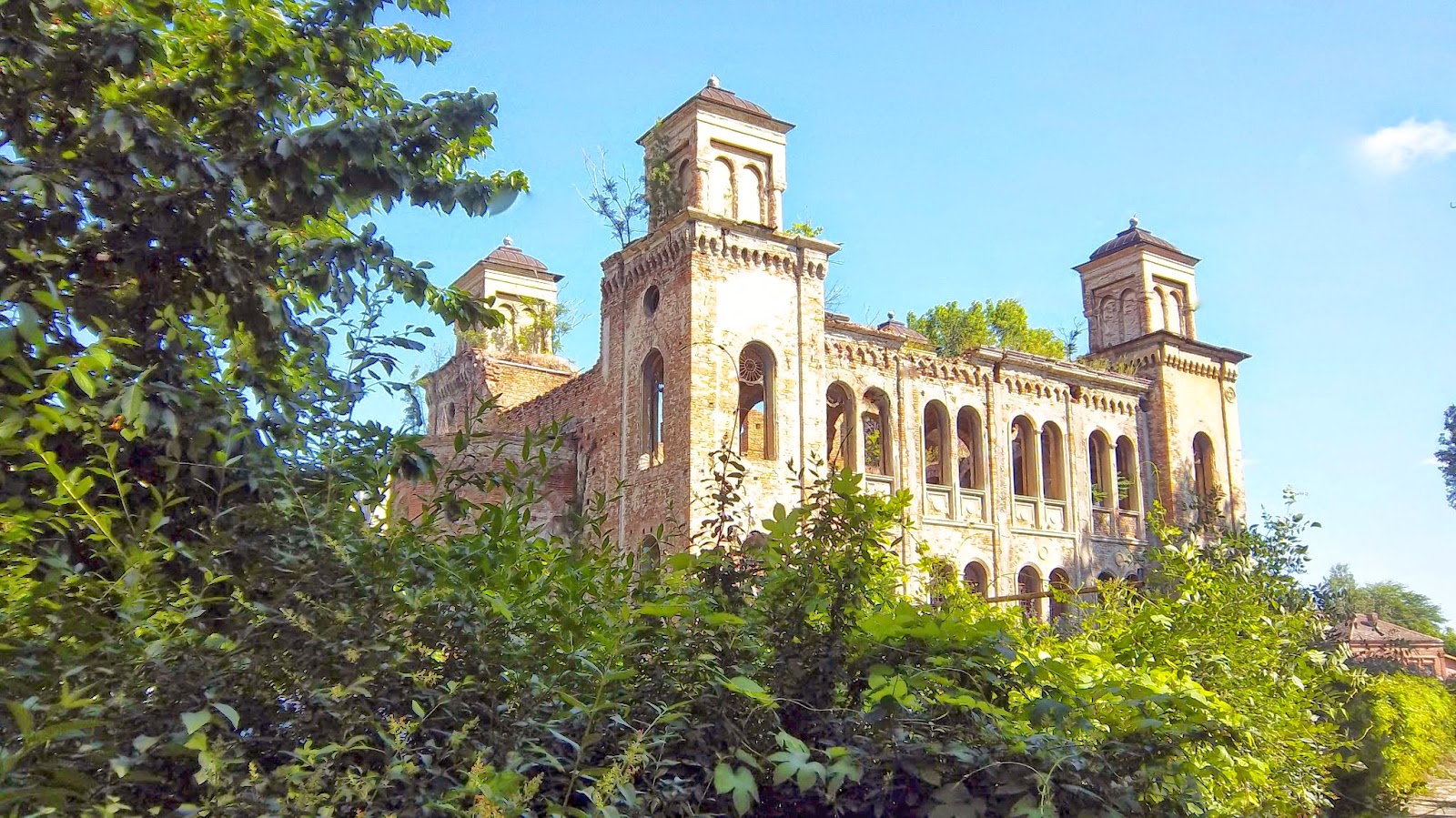
What's left of the Jewish Synagogue

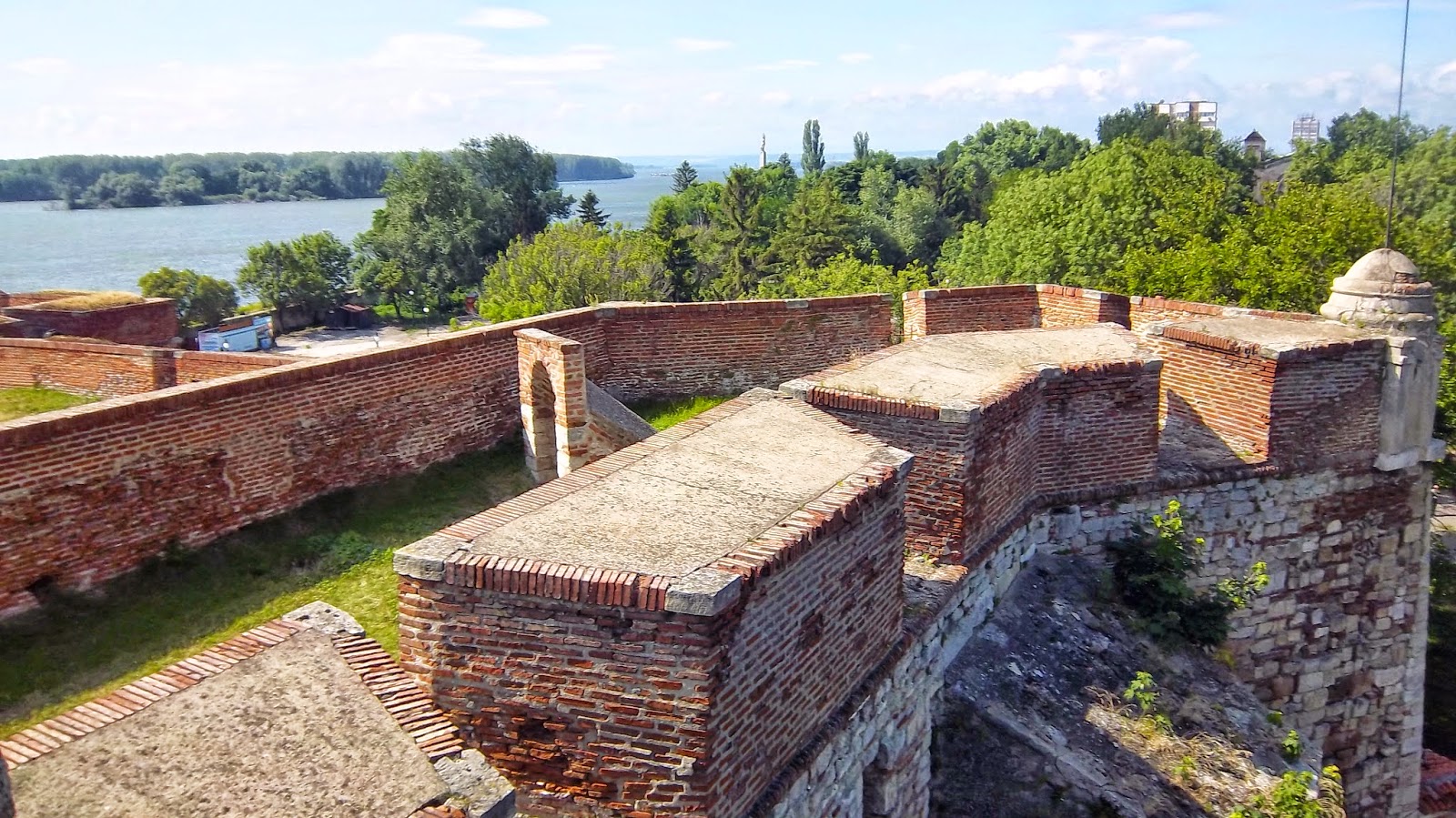
After our visit at the Mosque, we walked down to the Baba Vida Fortress.  This fortress was begun in the 10th century (900-999 AD, ahem) and took 400 years to complete.  It was an important fortress on the Danube protecting northwestern Bulgaria from the Turks. Unfortunately, in the late 14th century the Turks won and for the next 500 years Bulgaria would be an occupied region within the Ottoman Empire.  They ruled Bulgaria for 500 years, leaving it a strange mixture of East and West.

Baba Vida Fortress on the Danube
The Ottoman influence kept Bulgaria from developing as a Christian European State.  On  the  other hand, a religious awakening of  Christians in the late 19th century broke the hold  of the Turks over the area and in 1908 Bulgaria  asserted its independence.


Here is the link if you didn't get it as the title:
https://plus.google.com/photos/+LindaHarward/albums/5981889022647814177


Friday, January 3, 2014

Dresden

The Royal Palace of Saxony

 Dresden is a beautiful city.  You would never know it had been bombed to smithereens by the US in 1945.  I'm not sure they have "forgiven" us.  Our local guide commented on how "unnecessary" it was to bomb Dresden at the end of the war, but those of us who had just come from Warsaw had no sympathy for Dresden.  The bombing was the price they paid for supporting Adolph Hitler and letting him make war on the U.S.A.  Never a good thing to do, at least back then.  I suspect that if Hitler had lived in today's world,  the results probably would have been different.  The English no longer have the backbone they showed in the Battle of Britain, and the US is sick to death of war.

We began our first day in Dresden with a guided tour.  I mentioned the guide kept ragging on about what happened to Dresden.  After we entered the Zwinger, she had a local woman tell us all about the horrors she endured when she was a little girl, during the bombing of Dresden,   I couldn't really understand what she was saying, and I felt sorry for what she endured as a child, but I refuse to accept the collective guilt she tried to lay on us.   WE DIDN'T START THE WAR!  The Germans loved Hitler and supported him as their Fuhrer (leader).  They stood by and let the Nazis discriminate against the Jews, harass the Jews, take their property, and confiscate their businesses.   So they claim they didn't know about the murders.  They closed their eyes to it. 

That was then, this is now.  Dresden has recovered from the war and the subsequent Communist Era, and been completely rebuilt.  It is a beautiful and charming city.

People raved about the Green Vault in the Royal Palace.  I thought it was okay, but the Imperial Treasury in Vienna puts this little place to shame.  Plus, in the Green Vault they didn't allow pictures, which is my pet peeve.  The Hofburg Palace in Vienna let us take pix of all the treasury but wouldn't allow pictures in the Sissy Museum.

In Dresden we were blessed with great weather.  We were docked on the Elbe, May 16, BEFORE the floods came.  On 6/6 the Elbe overflowed its banks.  For the rest of our trip we would be taking the path of the floods, but before they got there. 
The map shows the map of our two river cruises.  We started in Dresden and finished at the Black Sea. 
Below we have a picture of the day we were there, and a picture of the flood.  It is the same bridge, but on the other side of the river.


Thursday, January 2, 2014

Eastern Europe to the Black Sea - BUDAPEST


Budapest - Castle Hill and the Chain Bridge at night
The Chain Bridge at night in Budapest
Last June Bob and I added another cruise tour to our East Germany cruise on the Elbe.  When we finished the previous tour in Berlin, we caught a train to Prague to begin our next adventure - Eastern Europe to the Black Sea.  After 4 days in Prague, in the rain, we traveled to Bratislava, Slovakia, where we had a tour and lunch - very neat little town, although Rick Steves didn't think too much of it!


Matthias Church and Fishermen's Bastion
We drove on to Budapest and arrived in the late afternoon.  We got settled in on the ship (the River Concerto), had a delicious welcome dinner, and enjoyed the sights of Budapest at night.
We had 3 Program Directors on this cruise.  Ours was Sorin, Crupa, the most adorable PD I've ever had.  He was just a baby, still in his 20's, handling a group of 40 old farts.  And he did it brilliantly.  I even tipped him more than I usually do! All 3 program directors were Romanian. Only Christian was old enough to tell us about life under the Communists.  His grandfather had a fairly prosperous farm and the Communists just came in and took it.   In Bucharest, Romania, we met  a man who had participated in the Revolution in 1989.  He was only 14 at the time, but filled with a deep desire to drive the Russians out of Romania.  They didn't seem to have a problem with communism, so much as with the Russians.  The Russians were hated and despised, all over the Eastern bloc.

That was a recurring theme all over Eastern Europe.  Over here we thought it was the fall of Communism; it was really just the fall of the USSR as they got booted out of the countries they had enslaved for 44 years.   Romania is the breadbasket of eastern Europe, but the Romanians starved because the Russians sent everything back to Russia.  We heard the same thing from the Poles on our first cruise.  In Germany we were shocked to find out some East Germans miss the old days, when life was "simple and easy."  In Budapest, our local guide told us "under communism we had a nice life, even though we could not speak freely.  Now we can speak freely but we have no life."  I wish we could have had a much longer conversation with the locals we met.  They have a totally different perspective than we do. 

Budapest is a gorgeous city and I thoroughly enjoyed our rain-free days there.  We had a city tour by bus, where we drove down Andrassy Ut. to Heroes Square, and on to the thermal baths.  I wish we had been able to return to the baths - they are supposed to be phenomenal!

The Széchenyi Thermal Baths
Instead, we went on an optional of the House of Terror, a place that under the commies, if you went in you didn't come out.
I didn't care for the museum but it did include more sights in the city, primarily Liberty Square.
Each room in the museum had a handout, in English, to explain the circumstances of what we saw.  Unfortunately, we had no time to read anything before we were off to the next room.  I brought all the papers home and still have not finished them.
Hungary has an interesting history.  They allied with Germany in WWI, and when they lost the war they lost 2/3 of Hungarian territory.  Then in WWII Hungary was caught between the aggressive Nazis and the hated communists, so they again sided with the Germans and paid the price for it when the US handed Eastern Europe over to the Soviets after the war.

The Berlin Wall falling was actually partly the result of the Hungarians allowing immigration to the  West.  It was a chink in the armor of Soviet power which gave hope to the people.  The Germans sent the Hungarians a part of the Berlin Wall in gratitude.


Thursday, December 5, 2013

Prague Castle


View of St Vitus Cathedral and Prague Castle


On the second day of our first trip to Prague, we packed up and left the hotel after breakfast, and headed
up the hill to Prague Castle.  It is a Castle on a hill.  There are various buildings and palaces within the Palace walls.  The Castle has guards, and a Changing of the Guard ceremony.  One of the guards was the drop dead gorgeous!


St Vitus Cathedral

Castle Gate/Main entrance
Courtyard II
After clearing the Gate, we started walking up a short incline, then went under an arch and came out looking at Courtyard II.  On the bottom of the left wing is an arch and entry into Courtyard III, and St. Vitus Cathedral. 

The best part of Prague Castle is the views.  We only went inside St Vitus Cathedral.  From there we passed through arches in various wings of the Castle, marveled at the beautiful architecture, and then saw the view of Prague from the Castle.  Amazing.
View from the Castle
Royal Palace
 
For a beautiful tour of Prague, check out my video:
https://plus.google.com/u/0/+LindaHarward/photos/photo/5943256794020687330

Prague - the First Trip May 13, 2013


Pretty cool Panorama, huh?  Eventually I'll get rid of the uneven borders.

Prague - 
Everyone I know, who has seen Prague, has been captivated by its charm.  Between our two trips, we spent almost a week in Prague or the surrounding area.   I am sure we only scratched the surface, but we did see all the usual tourist spots.  We marveled at the views from Prague Castle, we sampled Trdelnik, twice.  [It's essentially a cinnamon roll in granulated sugar, not icing.  Very, very good.]
We walked all over Old Town, taking photos of the beautiful picture-perfect scenes from every angle imaginable.  We spent an hour on the Charles Bridge alone! We also crossed the lovely but less well known Czech Bridge, the next bridge north of the Charles Bridge.

Our first trip, Essence of the Elbe, began in Prague.  After arrival day, we had another day and a half in Prague.  In the morning of Day 1, we had a bit of a bus drive around town, then took a walking tour not repeated in our next visit to Prague!  We started on the west bank of the Vitava River, walked up through a nice park to an outdoor exhibit at the Kampa Museum.  It was odd, to say the least.


We continued walking north through the Mala Strana, and finally arrived at the west end of the Charles Bridge.   We took our time on the bridge, since the weather was mostly sunny and there were so many great photo spots.    We wound up near Old Town.  From this point on, we saw the same stuff on both trips.  Both times we had a walking tour into the Stare Mesto, during which a local guide gave us a lot of information, I'm sure, but my senses were in full overload from the sights around me, I don't think I heard a word she said.  I certainly don''t remember anything.  We were dismissed for "free time" (including finding our own lunch), at the Astronomical Clock.

The afternoon was "at leisure"in Prague.  This means Grand Circle was running an optional tour, and those not participating got an afternoon "at leisure'.  Today's Optional was a tour of the Jewish places of note in Prague.  We didn't do it.

My husband, ever frugal, pointed out the old Jewish cemetery on the map and said "we can walk there ourselves" and so we did.  Took a couple of pictures on the street, peeked in at the cemetery itself, with caskets and headstones all askew.  We did the Great Rivers of Europe tour last year, and we got sort of Nazi-Jewish'd out.  Having just come from Auschwitz we were looking for something more upbeat! 


So we spent an enjoyable afternoon on our own, wandering about Prague.  Prague Castle was on tap for the morning, before we departed for Dresden and our riverboat, the MS Allegro.
Next Up:  Prague Castle

Tuesday, December 3, 2013

Poland - more on Krakow

Krakow has the advantage over Warsaw in that it sustained very little damage in WWII.  Its Old Town and Wawel Castle are authentic, no re-builds.  To that I say, I salute the people of Warsaw for rebuilding from the ashes.

Wawel Castle, Krakow, Poland
We arrived in Krakow in the early evening, so once we were all checked into the hotel, the Park Inn, our Program Director, Jutta (from Vienna) took us to Old Town on a local tram, showed us how to get back on the same tram, and cut us loose to find dinner on our own.  Bob and I found a wonderful little restaurant that served sea bass.  It was served head on, which we here in the US don't normally see.  I didn't think of taking a picture before I ate it, but I did get a shot of the carcass when I was done. Not quite the visual I thought it would be.

The next morning, after our "buffet breakfast" (see my other post today on European hotels), we went to Old Town again, but saw more of it.  We went to Wawel (pronounced VaVel) Castle which you can see is absolutely gorgeous).  We went to the Jewish Quarter, if that's what they still call it. 

We also went to a Memorial to the Jews Deported from Krakow and sent East . . . I found it very moving.


This was taken at what was the railway station during the Nazi occupation.  Each chair faces East, and represents 1000 Jews deported from this place. 

.

Today there are only trams, but where we see trams, those terrified people saw railway cars that were taking them some place they didn't want to go, and from which they would most likely never return.
But where did the Jews go?  Belzec extermination camp, Plaszow slave-labor camp, Auschwitz.  .  .  .

On our tour, we saw the Kazimierz District, which was historically the Jewish District from the 14th century until the Naziis wiped them out in 1943.   This was not the location of the Ghetto, however.  The Nazis moved all the Jews from Kazimierz to the Podgorze District,where they were crammed into a space that used to house 3000 people and now had to house 15,000.  This the Nazis established as the Jewish Ghetto, and nothing of it remains today except a plaque, if I remember right.  Helena Rubenstein was born in Krakow, in the Kazimierz.   We saw the Old Synagogue, and the Remuh Synagogue, and the outside of Schlinder's Factory.  Nothing meant as much to me as the symbolism of those chairs.  Some of our group had their pictures taken sitting in one of the Chairs.  I didn't think of it, but I now wonder if that wasn't a little insensitive of them?  The chairs represent Jews going to their deaths.  I'm not sure a blond Gentile sitting in that chair is appropriate.  But it did make for a nice vacation picture.